PCurbPass · parking, made neighborly
Proposal · Terwilliger Pointe HOA Draft for board review

Make the signs smart.

A parking system that solves who-can-park-where without a gate, without a guard, and without a big bill — built onto the signs we're already putting up, powered by the sun, and designed to be a good neighbor from day one.

Prepared by Jonathan Swanson, resident Version 1.0 — pilot proposal Try the demo below — it's live
The problem

We can't tell who belongs and who doesn't.

Guests, contractors, and the occasional stranger fill our limited curb space. Today enforcement means a neighbor confronting a neighbor, or nothing at all. We need a simple way to register who's allowed, give guests a temporary pass, and flag the cars that shouldn't be here — without turning the neighborhood into a checkpoint.

The idea, in one line

Your license plate IS your permit.

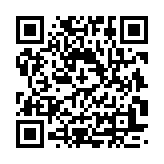
No hang-tags to lose, no stickers to print. Residents register their plates once. Guests get a self-serve pass in 20 seconds by scanning a QR code — the same code we print right on the new signs. A patrol or tow partner can look up any plate and instantly see authorized or not registered — and nothing else.

How it works

Three simple roles.

Residents

Register your vehicles once. Issue a short-term guest pass anytime — a wedding, a plumber, family for the weekend — right from your phone. Report a car that shouldn't be there with a tap.

Guests

Scan the QR on the sign, type your plate, done. A temporary pass is issued instantly and expires on its own — no paper, no code to keep, nothing to hand back. No smartphone? Call the number on the sign to register by phone — or a resident registers the guest for them.

Patrol & Admin

A tow partner or board member looks up a plate and sees only authorized / not registered — never personal data. The HOA admin manages the registry, guest passes, and warnings, and grants access in controlled tiers.

Live demo — not a picture

Tap through it yourself.

This is the real thing, running right here in the page. Switch between Resident, Patrol, and Admin to see exactly what each person would use. Look up a plate, issue a guest pass, check a sign's battery. Works on a phone, installs like an app, converts to a native app later. In the finished app, each person signs in with their own secure login (a username and password, like any app) — residents, patrol, and admin each get their own account. This demo simply skips the login so you can switch roles freely and see all three views.

Try: switch to Patrol and look up ABC 1234 — then a made-up plate.
P CurbPass
Terwilliger Pointe HOA
My vehicles
ABC 1234
Silver Subaru
Registered · you
OK
JSW 907
White van
Registered · you
OK
Issue a guest pass
Home
Patrol
Admin
Good-neighbor by design

Every objection, answered before it's raised.

The system is designed so the cautious questions a board asks are already handled in the hardware and the rules.

A human always confirms a tow.The camera only flags. No car is towed by a computer — a person reviews and decides.
Quiet at night.The spoken warning plays during the day only. After hours it's a silent light — no noise complaints.
No light in your windows.The warning LED points at the street and the car — aimed away from homes. Dark-sky friendly.
Privacy in tiers.Patrol and tow partners see only "authorized / not." Personal details never leave the HOA admin.
No gate, no guard.Nothing blocks the road, nothing to break, no arm to get stuck. Traffic flows normally.
Self-powered & green.Solar + battery. No trenching, no wiring permits, no monthly power bill.
No phone? Still covered.Call the number on the sign to register a guest by phone, or a resident registers them. Nobody's locked out.
A grace window, not a gotcha.An unregistered car gets a set number of hours — the board decides — to register or move before any tow. Warnings first, enforcement last.
The reason it's cheap

Built on things we've already agreed to pay for.

This isn't a new project bolted onto the community. Each piece rides on infrastructure that's already approved, already funded, or already proven a block away.

The new signs
The board is already installing updated signage. We print the QR code right on them. The core system goes live for the cost of ink — and the sign post becomes the mount for everything that comes later.
The landscape crew
We already pay a landscape company that's on-site every week. Swapping a flagged battery is near-zero added cost — and it answers "who maintains this?" before it's asked.
Proven solar
The construction company across the street runs solar traffic lights right now, through our winters, unattended. Our sign draws a fraction of that. It's not experimental — it's parked on our street.
Phased rollout

Start nearly free. Prove it. Then add.

Each phase stands on its own and proves value before the next dollar is spent. The board can stop after any phase and still have something useful.

PHASE 1

App + QR on the signs

≈ $0 + a few $/mo
  • Resident registration & guest passes
  • QR printed on the new signs
  • Patrol / admin plate lookup
  • Resident reporting of unauthorized cars
Solves the core problem
PHASE 2

Solar warning unit

≈ $250–400 / entrance
  • Blinking LED + daytime spoken warning
  • Solar panel + battery on the sign post
  • Health telemetry & low-battery alerts
  • Points away from homes; quiet at night
  • Optional digital display for live messages
Deterrence
PHASE 3

Plate-reading camera

≈ $250–400 / entrance
  • Auto-detects unregistered plates
  • Flags for a human to review — never auto-tows
  • Like the recycling center's plate cameras
  • Open-source recognition — no ticket, no booth
Automation
Cost breakdown

What we'd build vs. what a vendor charges.

Rough estimates for a two-entrance community. DIY figures are parts we assemble in-house; vendor figures are typical quotes for equivalent commercial products.

Phase / itemWhat it includesDIY (build in-house)Typical vendor
1 · App + QR Web app on Cloudflare, registry & guest passes, QR artwork on the new signsHosting scales free at our size $0–5 / mo $1,500–4,000 / yr
2 · Solar warning unitper entrance ESP32, 10–20W solar, charge controller, 12V battery + box, LED beacon, outdoor speaker, motion sensor, mountMounts on the already-planned sign post $250–400 $1,500–5,000
3 · Plate cameraper entrance Raspberry Pi + camera + night IR, weatherproof housing, larger solar+battery, open-source plate recognitionOptional cloud recognition ~$0–50/mo $250–400 $2,000–10,000
Sample two-entrance community, all phases ≈ $1,000–1,600 one-time $10k–40k+ & $2–6k/yr
~10–30× less than a commercial system — and most of the recurring vendor fees disappear entirely. The savings come from building on infrastructure we already own, not from cutting corners.
Honest note on the numbers: these are ballpark ranges to frame the decision, not a firm quote. Phase 1 is essentially free and worth doing regardless. Phases 2 and 3 are optional add-ons the board can approve one at a time, once Phase 1 has proven itself.
Power & upkeep

It powers itself and tells us when it needs help.

The maintenance question sinks most neighborhood tech. Here it answers itself: solar keeps the units topped, the system reports its own health, and the crew we already pay handles the rare swap.

1Solar tops it upA panel + good-sized battery keeps each unit charged — through cloudy stretches too.
2It reports inEach unit phones home its battery, charging, and online status on a light schedule.
3We're warned earlyA low battery flags SIGN 3 in the admin app before it ever goes dark.
4The crew swaps itThe landscape company swaps just that battery on their next visit. Never goes dark.
For the board — the upside

Free to us now. A way to lower our dues later.

Here's the part that makes this more than a convenience. I build CurbPass and give it to Terwilliger Pointe at no cost. Once it's proven working here, it can be licensed to the other communities AMS (Association Management Services NW) manages — and a share of that revenue comes back to Terwilliger Pointe to help offset our dues. The demand is real: other HOAs, and plenty of businesses, schools, and organizations, all struggle with the exact same parking problem.

Terwilliger Pointe

Free to use, forever — and a share of licensing revenue from every community that adopts it. Money flowing back toward our dues, not away from them.

Others who need it

Other HOAs, businesses, schools, and organizations face the same problem. Terwilliger Pointe becomes the proven reference next door — a working system, not a sales pitch.

Kept alive

I keep a small share to fund updates, fixes, and support — so the system stays maintained and current for years, not abandoned after launch.

The alignment: the more communities adopt CurbPass, the more licensing revenue can flow back to Terwilliger Pointe. Approving it isn't a cost — it's a small step toward lowering what we all pay.
The ask

What I'm requesting from the board.

Approve a low-risk Phase 1 pilot — the app plus the QR on the signage we're already installing. It costs almost nothing, commits us to nothing further, and lets residents start registering and issuing guest passes right away.

  1. Approve Phase 1 — put the QR on the new signs and turn on resident registration + guest passes.
  2. Run a 60–90 day pilot at one entrance and gather resident feedback.
  3. Review the results, then decide phase-by-phase whether to add the solar warning unit and the plate camera.

I'll build and maintain the app as a resident. The only decision on the table today is the small one — say yes to smart signs.